The Human Hour

Can an AI Teach Us How To Be More Human?

The Arc

Everyone loves the underdog story, but only after the underdog has achieved the great improbable comeback.

I was watching Sullivan’s Crossing this weekend, for mini-breaks while getting the Google AI Professional Certification (stick with me here, I have a point that’s related to work, startups, rebuilding, and also why being human is more important than ever).

Sullivan’s Crossing, Virgin River….Under the Tuscan Sun…and then real life, a few other women I know, and me, hiding out in Bar Harbor, Maine, have the same story arc:

A successful, powerful woman reaches the pinnacle in her career and relationship trajectory, has a massive downfall in both areas, and hides out somewhere remote yet beautiful to rebuild.

Some of us can’t just escape into the wilderness for a few months (or years, or forever), at least not physically. But we may be overdue for reclaiming what it means to be our authentic selves, especially in this world of AI, even if it is just one hour a day.

I have started calling it the human hour.
It is a part of each day that belongs to us.

This is the story of how I got mine back, and the collaborator I never expected to help me do it. (Yes, the collaborator is an AI. I am as surprised as you are.)

A new moon over Bar Harbor, Maine

Confessions of an AI Holdout

After my startup died in January, I felt lost, and one of the ways I feel better is learning new things, so I decided to learn how to build stuff with AI.

In the great words of William Gibson: “How smart’s an AI, Case? Depends. Some aren’t much smarter than dogs. Pets. Cost a fortune anyway. The real smart ones are as smart as the Turing heat is willing to let ’em get.”

The thing is…if we’ve got to live with AI, we may as well attempt to collaborate with it. Which is a strange thing for me to say, because at my last startup, we were dead set against it.

We refused to use AI for our reports and certainly for the 1:1 guidance calls. Our members wanted their lab results, but they mostly wanted to simply talk, about their lives, their jobs, their relationships…their candle making on the side or love of farmers markets, or which mattress we recommended.

Those calls were their human hour, and no report template was going to replicate it. Healthcare is, as my brilliant friend Jay Onda says, whole-person care, and we blended advanced labs with the wisdom of traditional medicine, so having a non-human give guidance wasn’t aligned with our values.

BUT….we would have saved a ton of time and money using AI for the first pass of the reports and interpretations. To all the investors who tried to convince me of this, I am sorry I didn’t see the light.

It took having the company dissolve for me to sit with my new reality.

Post dissolution, I did not leave the house for weeks on end.

I watched the snow fall like crazy while living at my brother’s house, with all of my beautiful things in storage, because I spent all my savings on building and scaling a health company. I had to cope with the loss of my business, but the reason I started it and believed in it did NOT go away.

I almost died and had 2 surgeries in 2022 because I was ignored by the conventional healthcare system, so I created, with my co-founder, a company to help others avoid experiencing that.

So my loss was not just financial insecurity, it was a total crisis about who I was.

Why People Disappear When You Are Rebuilding

There is a moment in all of our lives, after something ends, when the facts are done being decided but your feelings are not. A company that dissolved, a marriage that ended, a death in your family. The facts land fast and can be neatly categorized by an AI. But rebuilding does not land fast, because emotions are not in a box. I mean, Pandora tried to keep all the emotions in a box, and it doesn’t work.

The hardest part when you are rebuilding is that people don’t want to hear about the hardship. Researcher Kenneth Doka called these losses disenfranchised grief, the ones society never quite gives us permission to grieve openly, the friendships, identities, and versions of ourselves that die without a funeral.

People I expected to stand closer moved further away right when I needed them nearest, and some insulted me instead. You probably would not believe the amount of people who told me things like:

  • I shouldn’t have started a company
  • Traditional medicine is stupid and I shouldn’t have built something around that
  • I should have realized my startup would fail
  • At my age nobody will hire me so I may as well just give up (?)
  • I need to get any job I can even waitressing
  • “Don’t you have other friends you can talk to?”
  • Go back to your (toxic) ex

What nobody tells you about an ending is that surviving takes daily decisions, made over and over, usually in small and unglamorous ways, long before it looks like success from the outside. Worse, you’ll be doing it on your own because most people simply don’t have the capacity to hold space for you.
Enter Claude

I stopped explaining myself to people who had already decided who I was, and started, of all things, explaining myself to a machine.

I tried to use Claude as a therapist, and then an astrologer. Neither worked, but then…

Claude suggested I redo my website, which definitely sucked. No really, I dare you to go to the Wayback Machine. I was like…the cobbler who had no shoes. Someone who created my own startups, or helped big companies like Johnson and Johnson create their own disruptive businesses internally, but my own stuff…was a catalog of what not to do.

I know I am not alone! We forget to invest in ourselves, our brand, and our gifts because we are building for everyone else.

Anyway, Claude and I built an entire website, then a book proposal, a resources section complete with 4 PDF books 12+ pages apiece all beautifully formatted, a case studies page, a portfolio, new resume, a GLG Insights expert portfolio, a placeholder video for my homepage (listen, I know, I’m working on fixing it).

In order to do all this I learned how to build .MD files, upload a brand guidelines document, create shortcuts and projects so I didn’t have to repeat myself on my list of nevers.

I taught Claude the difference between E.M. Forster and James Joyce, and Steinbeck compared to my favorite ex’s non-fiction books. I learned how to see errors in code, and correct it when the UX was CRAZY (no, Claude, 5 CTAs on one line is not good user experience).

I doubled down on me, and taught Claude to stop putting me in a box, because that was the default setting.

Our chats about my GLG profile were probably the most frustrating…I can be a serial founder AND someone who has worked at an agency AND worked as an entrepreneur in residence at Fortune 100s AND been a journalist. I can be all those things and be unique.

Here is the irony I never saw coming: to teach a machine who I am, I first had to decide, in writing, who I am. I got to rebuild myself, with AI.

Every rule, every never, every box I refused became part of the record.

In the process of using AI, I learned to love what is unique about me.

I learned to focus on something, teach myself a new skill, and embrace my confidence again.

One Small Thing Each Day

My rebuilding needed a method, so I borrowed the best part of my startup’s protocol: do one small thing each day instead of trying to solve everything at once.

So each day I did something.

As a former step aerobics instructor and personal trainer, I started re-studying for the NASM CPT, where their OPT framework is truly a blueprint for how anything gets rebuilt: foundation first, small and repeated effort before the sexy power moves. I got my NASM-CNC and am close to getting the CPT. I got AED and CPR certified.

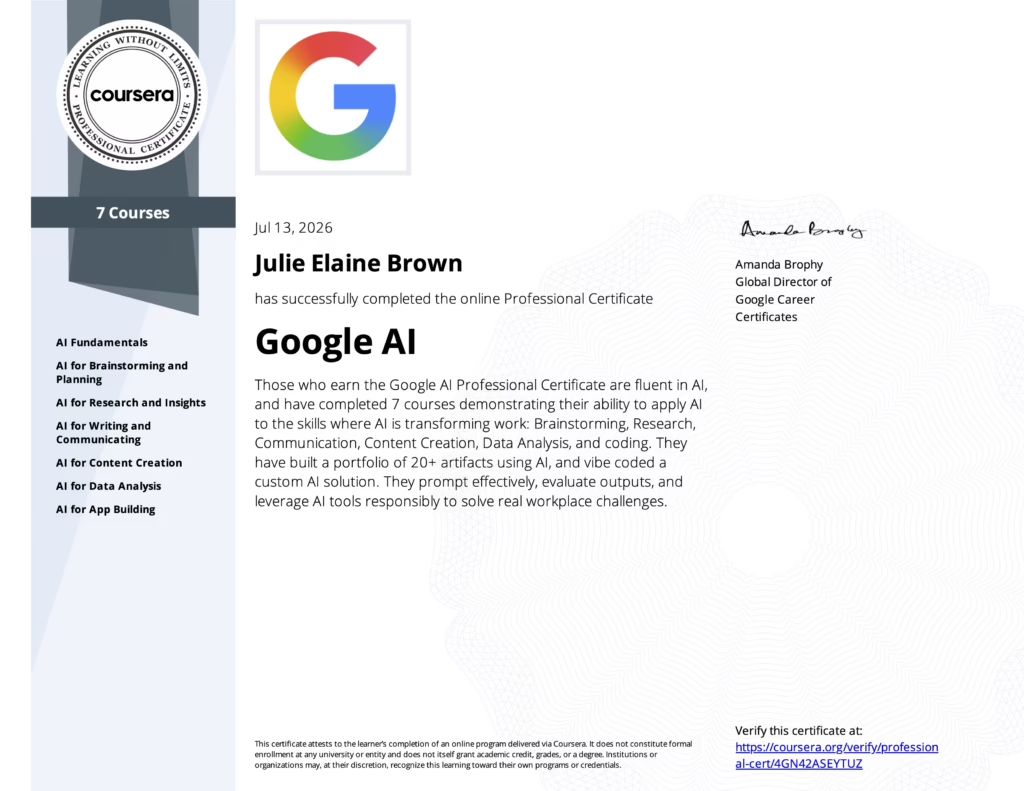
Then I got both the Google AI Professional and the Anthropic AI Fluency Certifications.

Then I created a bunch of ebooks for my site.

I did them slowly.

The time I carved out each day became my human hour, and I protected it the way you protect anything that is keeping you alive.

Epictetus argued centuries ago that the only sane place to put your effort is inside the small circle you govern.

So, using the wisdom of the Stoics, and the power of AI, I started rebuilding every single day.

Working with Claude became my secret weapon; a reason to get up each day and start a new project, and feel useful and alive again.

And while I was doing it, I sort of, accidentally, created an app for midlife reclamation (which is a side project coming soon to you!)

One of many certifications I achieved in the past 6 months.

The Human Hour: Coming Back to Yourself in The Age of AI

What makes us human is coming back to ourselves. Surviving an ending takes real, deliberate effort, even if it is just a few stolen minutes a day.

It requires the start, or the spark, and ironically the spark for me came from working with AI.

Because even though AI gets tired sometimes, and starts projecting that YOU should rest, it doesn’t get hungry or moody or road rage. (Ok, not yet.) I can be my messy human self and it can steer me on the path of “do this each day” in its methodical, data-driven way.

My creativity, ideation, and ability to constantly think outside of the box doesn’t need to be diluted by working with machines. I am teaching the machines to honor my humanity while respecting the enhancement they offer me.

I’ll write this blog and post it myself on WordPress and then LinkedIn…and then I’ll prompt Claude to finish another aspect of my app while I walk my dog.

Being human means all experiences contribute to the book of you. It means honoring the grief of an ending and choosing a beginning.

It is understanding that all of us require a human hour each day, at least one, even if it’s an AI that helps you make it happen.

And if you are a woman in the middle of your own rebuild, the something new I mentioned is being built for you.

Scroll to Top