Some Things Can’t Be Solved at a Desk
What a Vermont Forest, an Elderly Dog, and an Unexpected Dinner Taught Me About Clarity
I had been circling the same strategic question about my startup for three weeks. I had stared at decks, rewritten positioning documents, talked it through with people I trusted, used Claude, ChatGPT. Nothing was landing.
So I did what I have learned, after a lot of expensive resistance, actually works. I drove two and a half hours north with my sixteen-year-old Jack Russell and let the woods do what no amount of focused effort could.
By Thursday afternoon, after two days of trails, cold air, and the particular quality of silence that exists between trees, I had my answer. The forest cleared enough noise that I could think clearly. It’s no wonder that an entire field of medicine is built around forest bathing.
Participants who walked in the forest showed an increase in subiculum volume in the hippocampus, the brain’s memory and stress regulation center. The subiculum specifically acts as a gatekeeper, deciding how much stress signal the brain continues to process. When its volume increases, it becomes better at putting the brakes on anxious, circular thinking.–Max Planck Institute for Human Development in Berlin
Shinrin-Yoku or Forest Bathing
The term shinrin-yoku was coined by Japan’s Ministry of Agriculture, Forestry and Fisheries in 1982 as a public health initiative. It translates roughly as forest bathing, and it means exactly what it sounds like: making full sensory contact with the atmosphere of the forest and being present with all your senses open.
A systematic review and meta-analysis published in the International Journal of Biometeorology and a 2024 study published in Frontiers in Psychology showed people’s stress (measured by cortisol levels) were significantly lower after forest bathing, that blood pressure decreased, and people reported feeling more relaxed three to five days after a single experience in the woods.
Forest bathing increases natural killer cell activity and the intracellular levels of anti-cancer proteins, while simultaneously stabilizing the autonomic nervous system toward parasympathetic dominance. In plain language, it turns down your fight-or-flight response and turns up your body’s capacity to repair and defend itself against cancer, among other less nefarious diseases.
Now you start to understand why doctors in Japan will often prescribe forest bathing before pharmaceuticals.
Forest bathing has also been shown to help us stop ruminating, and think clearly. The Max Planck Institute for Human Development in Berlin had sixty participants walk for one hour in either a forest or a busy urban street, with high-resolution hippocampal imaging before and after.
Participants who walked in the forest showed an increase in subiculum volume in the hippocampus, the brain’s memory and stress regulation center. The subiculum specifically acts as a gatekeeper, deciding how much stress signal the brain continues to process. When its volume increases, it becomes better at putting the brakes on anxious, circular thinking.
No change in the hippocampus was observed after the urban walk.
The brain, with just one hour of forest bathing, responds by putting the brakes on stress and helping us process information more clearly.
The Perpetual Urgency Problem
Here is what I observe consistently among founders, executives, and high-performing women: the busier they are, the more fiercely they resist going offline and immersing themselves in nature.
Time off, especially if not with a specific directive such as “work out” or “network” gets treated as indulgence. Something you earn after the deck is done, the quarter closes, the crisis resolves. Except the crisis is never resolved, because a brain running on elevated cortisol is not solving problems well.
Researchers call this Directed Attention Fatigue, the cognitive drain that accumulates from sustained focused effort. Nature and the quality of attention it produces is one of the few documented ways to restore this capacity.
The connection between a forest walk and executive function is not only the key to clear thinking, but also the key to better health in general.
Let It Go
I had planned to do takeout from a restaurant in Manchester on my first night. When I called, the owner told me they did not really do takeout. I explained I had my dog. She said bring him and come sit at the bar.
What followed was one of those evenings that only happen when you stop trying to control the outcome. Dalton, sixteen years old and completely unbothered by the world, sat at my feet and was brought brisket by the kitchen.
I met new people, was told about a secret local hike, and left three hours later having barely touched my wallet. It was one of the best meals I’ve ever had in one of the most beautiful restaurants.
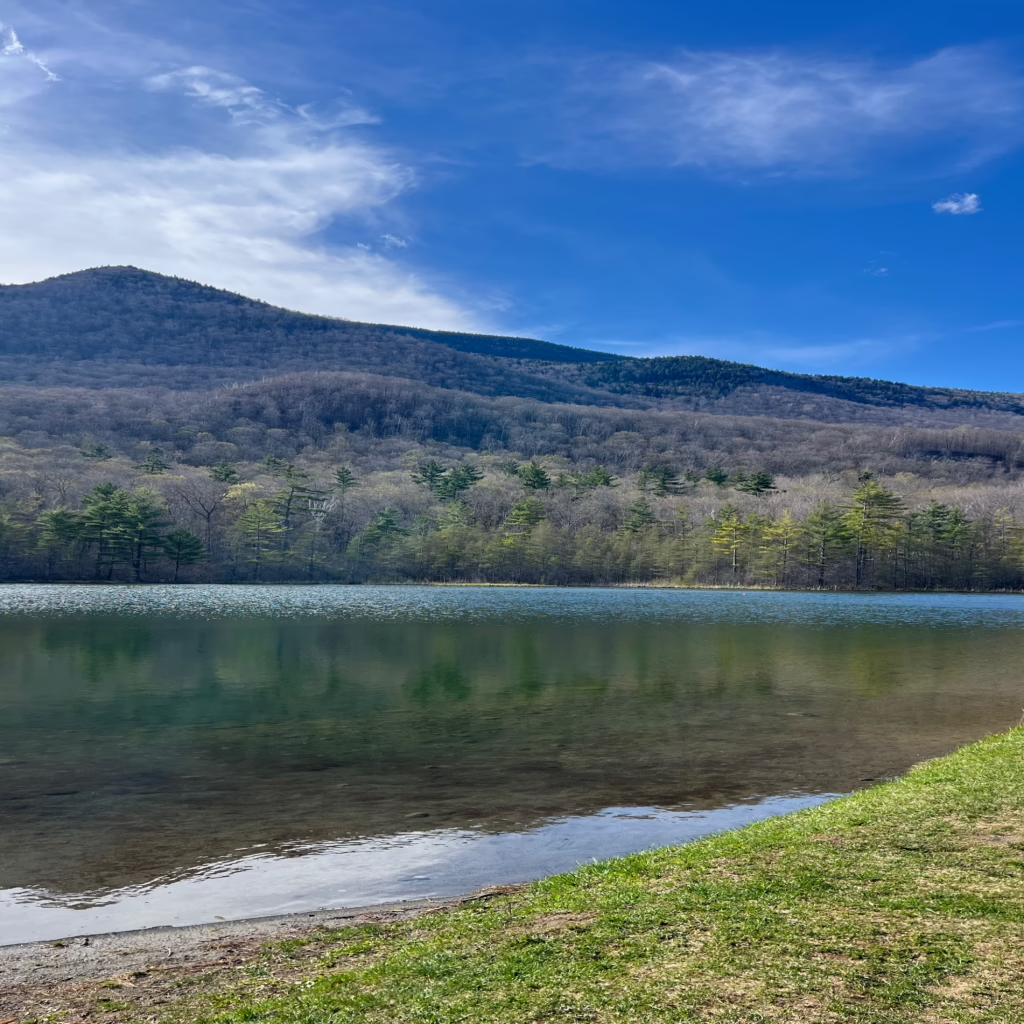
The next morning, we walked more than three hours in the deep woods toward a waterfall. It was misty and muddy and hawks circled above. The only real sound was the waterfall roaring in the distance (and then, less than 100 feet away).
That night, I knew what to do with my entire methodology: the branding, the launch plan, even the tagline. I realized I was trying to control the methodology and outcome and lead with that, but everything needed to lead with how my audience would FEEL after going through the program.
It sounds pretty obvious now that I write it.
The forest did not solve the problem.
It created the conditions under which I could.

How to Get Clarity From Nature
If you’ve been ruminating on a problem or are in a constant flight or fight mode, or simply want to reduce your stress, look to nature for the key.
Find Some Trees or Nature
Research shows that even twenty minutes of nature exposure three times per week yields measurable reductions in salivary cortisol. A city park qualifies or even a patch of grass.
See the Forest in Your Mind’s Eye
Even virtual reality forest environments, or a deliberate visualization practice have shown measurable physiological stress reduction. Close your eyes. Slow your breathing. Put yourself in a specific place in nature that you know, with the sounds and the smell of the air intact. Your nervous system responds to the image when the image is vivid enough.
Slow Down and Pay Attention
Walk slowly and take in the sounds, sights, and smells. Look up and see birds and the canopy of leaves above you. Feel the crunchy ground beneath your feet. Take a big, deep breath.
Leave the Electronics Behind
Leave your phone in your pocket or, better, leave it behind entirely. Nature’s cognitive benefits are partly a story about what you are removing, not only what you are adding.
Get in The Woods as Often as You Can
Make forest bathing a regular practice, ideally even once a week or more. Three twenty-minute nature experiences per week produces more durable change than one long expedition every few weeks.
Spend an Hour in the Woods
What problem have you been circling that you cannot seem to solve?
Carve out one hour in the next week and walk in the forest. Take your time and notice everything. Don’t count steps or think about losing weight. Just be one with nature.
Then come back and tell me what shifted.
Like this article and want more tips on living well?