You May Already Be Reversing Your Age Without Knowing It
What If a Younger Biological Age is The Ultimate Secret Weapon?
When I talk about reversing biological age, it tends to spark one of two things. Excitement or resentment.
The resentment is interesting to me, honestly, especially as it tends to come from other women some of whom have been outright hostile about it.
Not skeptical in the way a scientist is skeptical, open to evidence, willing to be wrong but personally hostile, in a way that is disproportionate, so of course that got me thinking about why people dismiss the very real possibility of reversing age, when daily choices such as a long walk, real food, time with people you love, are doing exactly that.
You may not believe something is possible at the same time you are living proof that it is.
Neuroplasticity, the brain’s capacity to form new connections and adapt, does not close at forty or fifty, and the same choices that shift your epigenetic clock are measurably shifting your cognitive age. As Mayo Clinic expert Prashanthi Vemuri, Ph.D., has found, we can learn a new language, new skills, get a degree, and more as we age.
The science of biological age reversal turns out to be, at its root, also the science of being fully alive.
You may already be reversing your clock without knowing it, and it might be one of the most important things you can do to ensure your second half is better than the first.
Imagine combining all the wisdom and years of experience with vitality and stamina?
The Science of Being Fully Alive
Refusing to believe we can reverse aging may stem from self-protection. Being near someone who is doing what you have privately decided cannot be done is genuinely uncomfortable.
Women in particular are expected to make a certain peace with the symptoms of midlife, the fatigue, the hormonal chaos, the gradual softening. I have been asked sincerely why I would even want to extend perimenopause, as if the only question worth asking is how to survive it rather than whether it has to look the way most of us have been told it looks.
My answer is that I no longer have any of those symptoms.
There is something quietly subversive about the research on the world’s longest-lived populations. The people on the Greek island of Ikaria, where one in three resident lives into their nineties and dementia is nearly nonexistent, are not following biohacking protocols or spending Bryan Johnson’s rumored two million dollars a year on longevity interventions.
They are walking up hills to visit neighbors. Eating from their gardens. Napping without guilt. Sharing wine at festivals that run until midnight.
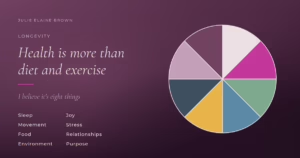
Researcher Dan Buettner, who has spent decades documenting these Blue Zone communities, found that the common denominators were not supplements or clinical interventions but purpose, community, movement woven into daily life, and the deep biological signal that comes from feeling genuinely connected to other people.
Age Reversal is a Matter of When, Not If
The science behind these numbers is worth understanding, and it has been moving fast.
In January 2023, David Sinclair, professor of genetics in the Blavatnik Institute at Harvard Medical School and co-director of the Paul F. Glenn Center for Biology of Aging Research, published research in Cell that his team described as a paradigm shift.
Thirteen years in the making, the study demonstrated for the first time that epigenetic change, meaning the gradual loss of the chemical instructions that tell our cells which genes to activate and which to silence, is the primary driver of aging in mammals, and that restoring those epigenetic patterns reverses the measurable signs of aging throughout the entire organism.
Not slows: Reverses.
“It’s like rebooting a malfunctioning computer,” Sinclair said of the therapy used to restore youthful cellular function in the study animals (small note here that I personally do not condone animal testing and I would gladly be a research subject!)
“The therapy set in motion an epigenetic program that led cells to restore the epigenetic information they had when they were young.”
The FDA has since approved the first human trial of epigenetic reprogramming therapy.
Speaking earlier this year, Sinclair said that most people do not believe age reversal is possible simply because it has never happened before, and he compared the skepticism to what the Wright brothers faced.
The question, he said, is no longer whether it will happen. Only when.
Our Bodies Respond
A 2023 study by Dr. Kara Fitzgerald and colleagues, published in the journal Aging, followed six women between 46 and 65 through an eight-week program of dietary changes, consistent movement, improved sleep, and stress reduction.
Five of the six showed a measurable reduction in biological age as calculated by the Horvath epigenetic clock, ranging from just over a year to eleven years, with an average decrease of 4.6 years.
Eight weeks is all it took, through interventions available to anyone.
A separate analysis of strength training data across more than 4,800 American adults found that those who trained with resistance had significantly longer telomeres, the protective caps on our chromosomes whose length is one of the most studied markers of cellular age, compared to those who did not.
The body responds to what we ask of it.
What You Believe is Possible Determines What Is
The epigenetic research is particularly clarifying. Our genes are not a fixed program running to a predetermined conclusion.
They are more like a library, and what the epigenetics field has established over the last decade is that our lifestyle choices determine which books get opened and which stay on the shelf. DNA methylation, the mechanism through which many of these changes operate, responds to what we eat, how we move, how we sleep, and how we manage stress.
The Horvath Clock works by analyzing those patterns. When they shift in the direction of youth, the clock reflects it.
Belief is never really only about the body. There is a body of research in cognitive psychology showing that when a belief is deeply connected to our sense of identity, we do not evaluate new evidence neutrally, we protect our most comfortable story.
When we dismiss the possibility of reversing our biological age, we are often protecting ourselves from our greatest fears: that we may be powerful and vibrant and amazing, even as we age.
As Marianne Williamson has said, “Our deepest fear is not that we are inadequate. Our deepest fear is that we are powerful beyond measure. It is our light, not our darkness that most frightens us.”
“Our deepest fear is not that we are inadequate. Our deepest fear is that we are powerful beyond measure. It is our light, not our darkness that most frightens us.” –Marianne Williamson
Leaders Who Think They Are Done (But Really Just Need To Be Seen)
There is a particular kind of exhaustion that belongs to the high-performing leader who has been building for decades. She has run companies, led teams, made decisions under pressure that most people will never face, and she has done it while managing a body that the medical establishment spent years dismissing.
At some point, she starts to wonder if the dimming she feels is simply who she is now.
It is not.
What the epigenetic research establishes clearly is that the same inputs that reverse biological age restore executive function: Sleep quality, movement at intensity, the removal of chronic stress, genuine social connection: these are the conditions under which a high-performing brain and body return to form.
Purpose, which the Blue Zone researchers identified as a primary longevity signal, is also one of the most documented drivers of cognitive sharpness and emotional resilience at midlife.
The leader who feels she has aged out has almost certainly not. She may simply be living in the wrong conditions. The best thing she can do for herself, her purpose, and her leadership is live the life that fuels her longevity.
Reversing age becomes a leadership credential.

Do You Want It?
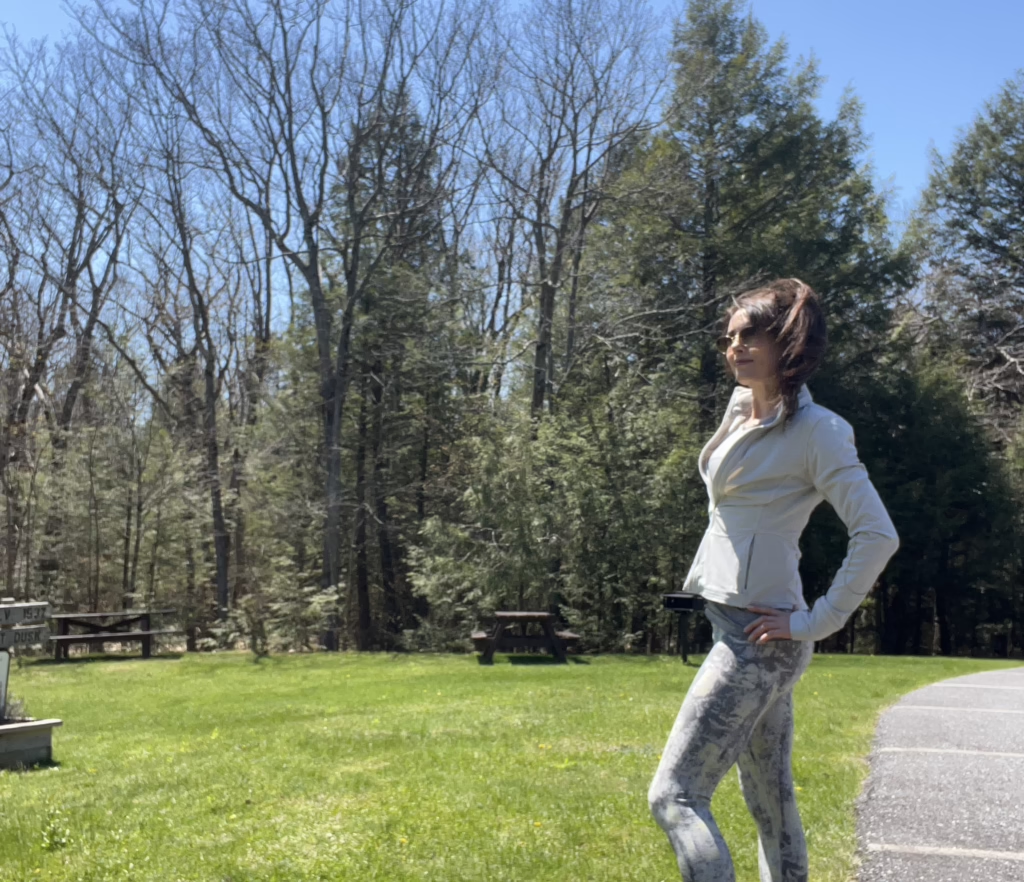
A few days ago, I was in Amherst and someone assumed I was a graduate student. I am 52 and I have been through one of the more difficult stretches of my adult life.
My biological age is 13.6 years younger than my chronological age. I arrived at that through telomere length testing and organ-based biological age analysis, which looks at how the heart, liver, kidneys, and other systems are functioning relative to population norms. None of the tests I take are exotic or prohibitively expensive, and many can be ordered direct through the lab without a healthcare professional.
How I reversed my age was the result of a lifestyle overall after two surgeries in 2022. I had been healthy (or so I thought) my whole life, being either a vegan, vegetarian, or pescatarian since the age of 12, exercising every day, hiking in the woods.
But I was a stress ball and spent years in a toxic relationship and didn’t sleep enough, and those three things undermined everything.
Post surgeries, I started to train differently, with HIIT and sprint training and bodyweight strength work—things some people used to say midlife women shouldn’t do.
I sleep with intention: blackout curtains, no blue light, an eye mask and I start winding down three hours before bedtime. I spend more time in forests, because the research on what time in nature does to cortisol and immune function is genuinely compelling.
I take acupuncture and Traditional Chinese Medicine seriously enough that it inspired my last company, Rêve Health, which interpreted biomarker labs through a traditional Chinese medicine lens.
None of these things are prohibitive for most professionals: but you have to make the time for it, and you have to want it.

Reclaiming You
The women I am building my next work for are those who feel the pull of something better and feel something shift in them.
The women who remember they used to believe in themselves and trust that they could do or be anything.
And of course, life gets in the way especially as women who build other peoples’ lives instead of our own. But at some point, we can decide to reclaim ours.
The door is open longer than you have been told.