Why You Can Only Do So Much
You Can Only Do So Much
I was speaking with a former startup client the other day, a woman in her early fifties with a brilliant mind, overworked, under-appreciated, and guilty of what so many of us are at this age: doing too much. She told me that she had placed one important goal on the shelf for now.
She was happy and fulfilled in a relationship, spent the weekends doing something she loved, and had built a comfortable home. But she no longer had the bandwidth to focus on her career.
When she said, “I can’t dilute my energy,” I told her she is brilliant for focusing on what matters to her right now. We can only do so much.
Our culture tells us that more is better and multiplying commitments signals success. Yet modern neuroscience and cognitive psychology paint a more honest picture. The idea that humans are natural multitaskers is largely a myth. When we think we are multitasking, we are actually switching rapidly between tasks, and every switch carries a measurable cognitive cost.
Something Has Got To Give
Researchers at Stanford University confirmed this. In a study published in the Proceedings of the National Academy of Sciences, Eyal Ophir, Clifford Nass, and Anthony Wagner found that heavy multitaskers were “more susceptible to interference from irrelevant environmental stimuli” and showed a “reduced ability to maintain focus on relevant information.”
In other words, juggling multiple streams of attention does not enhance performance; it fragments it. The American Psychological Association summarizes this body of research by noting that multitasking can reduce productivity by as much as 40 percent.
Neuroscientific explanations help us understand why this is so. The prefrontal cortex, the part of the brain responsible for executive functions such as planning and decision-making, becomes significantly less efficient when trying to process multiple stimuli at once.
When we spread our attention across competing demands, our capacity for deep thought, memory consolidation, and creative problem solving all diminish.
What does this mean for women in midlife? It means that we cannot do it all at once without paying a price.
We are celebrated for managing work, home, relationships, caregiving, hobbies, side projects, and personal growth, but when attention is divided, something always gives. As we age, many of us are literally sandwiched between the needs of aging parents, and the needs of children.
Many of us are also at the height of our professional careers, while simultaneously dealing with the myriad of health issues that pop up during perimenopause and menopause.
Focusing on what matters is critical at this stage of life.
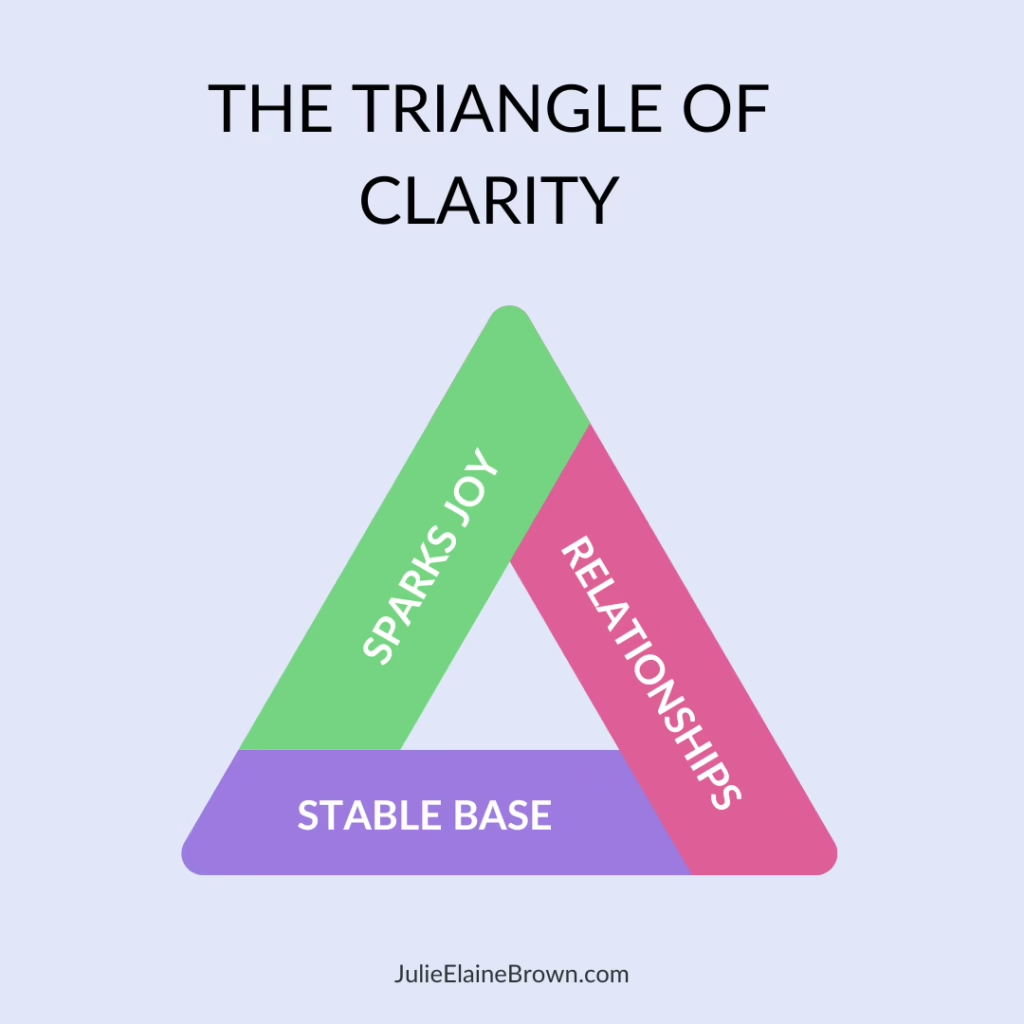
So, what matters? While we all have our individual desires, I’ve found that our health, the quality of our relationships, and having something we truly enjoy are key to thriving in midlife.
The Triangle of Clarity
I have come to think of the important elements of life in three interconnected points, and I imagine a triangle, not unlike some illuminati logo but very different in meaning.
One Thing You Truly Adore (Sparks Joy!)
What is one thing that genuinely feeds you at a deep level, whether it is your work in the world, a creative pursuit, or a form of study that you look forward to? Marie Kondo coined the phrase “sparks joy” and there really is something to this in terms of choosing things each day that light you up.
In a foundational paper, Edward Deci and Richard Ryan write, “The most robust finding in the research literature is that intrinsic motivation is enhanced when people experience autonomy, competence, and relatedness” (American Psychologist, 2000). When you focus on something you love and feel internally aligned with, you are more likely to persist, perform well, and experience wellbeing.
A Few Core Relationships
It is not about the number of people you know or how visible you are. It is about a few relationships that truly matter, the ones that leave you lighter, not drained, and resonate with your life.
The Harvard Study of Adult Development, which has followed participants for more than eighty years, repeatedly finds that these close connections are one of the strongest predictors of long-term wellbeing.
As the current director, Dr. Robert Waldinger, puts it, “Good relationships keep us happier and healthier. Period.”
A Stable Base
Stability may sound unglamorous, but it is foundational. Like Maslow hierarchy of needs, without food, shelter, and safety we cannot build or create a life of intention.
This usually means a dependable source of income, a home that feels like refuge, routines that cultivate health rather than erode it.
Now many of you know that as a multiple-time startup founder, I’ve spent many years, even decades, building in uncertainty and not getting paid. Now that I am 52, and just had a failed startup, I’ve changed my views on going all-in on a dream. I think, socially if you want to avoid outside capital, it’s important to slowly work on something on the side while protecting your income.
That doesn’t mean you don’t do something each day to step toward a riskier goal—but it means prioritizing the base.
Research in stress physiology consistently shows that chronic uncertainty elevates cortisol and strains cognitive function.
When basic needs are reliably met, the nervous system is freer to allocate energy toward higher order thinking and creativity. The triangle stands more firmly when its base is secure.
Making it Happen
Identify your three focus points for this season and write them down in complete sentences. Then:
Wisdom in Letting Go
I’ve never understood why society dismisses the wisdom and experience of midlife women–but rest assured I believe in you and know you have the answers inside of you.
You know when you feel relieved, joyful, and free.
Freeing up your time and energy to focus more on those things seems obvious, and often, we simply need to give ourselves permission to do so.
Take a moment and give yourself permission to love your life, and focus on the things that matter!