As We Lose Light, We Become the Light
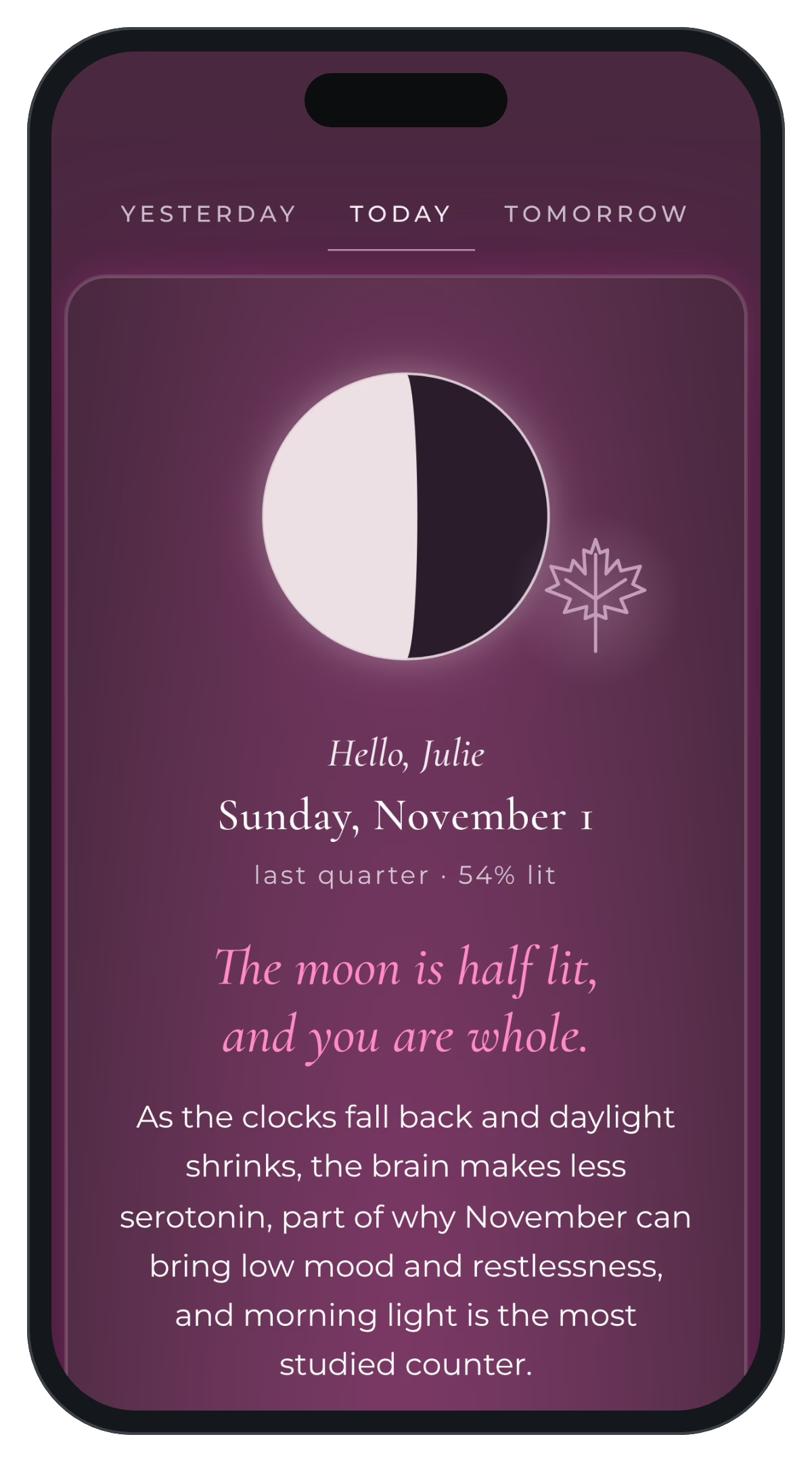
On Sunday, November 1, the clocks fall back an hour. In Boston the sun that set at 5:37 on Saturday sets at 4:36 on Sunday, and by the last day of the month it is gone by 4:11. We lose an hour of evening overnight, and November takes roughly another hour of daylight on top of it.
Every living thing around us is reading that light. The maples began letting go of their leaves weeks ago, long before the first frost, because what they watch is the length of the day. As the light thins, a tree draws the nitrogen and sugars out of each leaf and stores them in its branches and roots for spring, and only once it has taken back what it needs does it let the leaf fall.
We are reading the same light. The pull toward bed at eight o’clock, the craving for something warm and heavy, the wish to stay in, the sadness that can arrive with the early dark: this is our biology answering the season.
We are a part of nature, and November is the month we can feel it most clearly. It asks the same things of us that it asks of the trees, to let go of what is finished and to root down for winter.
The Light Tells Our Bodies to Turn Inward
The body sets its clock each morning by the light that reaches the eyes, and as the days shorten, that signal weakens. When the nights grow long, the body secretes melatonin, its hormone of darkness, for more hours of the night, which Thomas Wehr showed at the National Institute of Mental Health. The clock change asks even more of us. In Danish national data published in Epidemiology, depression diagnoses rose eleven percent after the clocks fell back to standard time, an effect that faded over about ten weeks.
Our sleep follows the season too. In a sleep clinic study published in Frontiers in Neuroscience, people spent about half an hour more in REM sleep in winter than in summer and tended to sleep longer overall. The body wants more rest in the dark months while our calendars stay exactly the same, and much of the November tiredness lives in that gap.
The sun gives less in other ways as well. At Boston’s latitude the winter sun sits too low for the skin to make vitamin D, and from about November through February the skin makes little or none, however long the walk.
Why We Crave Warm, Heavy Food
We eat more in the fall than in any other season. When John de Castro tracked what people ate across the year, daily intake peaked in autumn, with larger meals eaten more quickly. Part of the reason is the light. With less daylight the brain makes less serotonin, and carbohydrates help the amino acid tryptophan reach the brain, where it becomes serotonin, which is one reason bread and sweets call so loudly in November. The body is also preparing for cold, the way every animal around us is.
The craving makes sense, and it points us toward the right foods. Roots and squashes give the body the warmth and steadiness it is asking for, with the fiber that keeps blood sugar even: sweet potatoes, pumpkin, carrots, beets, and parsnips, roasted until they caramelize.
Traditional Chinese Medicine, a system roughly four thousand years old, reads late autumn the same way. It belongs to the Metal element and to the Lungs, its climate is dryness, and the foods it favors moisten and ground: pears, baked or poached, white foods like daikon, cauliflower, and white beans, a little ginger and garlic to open the breath, and dark foods like black sesame and black beans to prepare the body for winter.
Movement That Roots Us
Movement matters more in November, when the light alone cannot carry our mood. A 2023 umbrella review in the British Journal of Sports Medicine, drawing on ninety-seven reviews, found physical activity improved symptoms of depression and anxiety across adults of every kind. Moving outside in the morning gives us two medicines at once, since the first light of the day is the strongest signal the body gets to hold its rhythm steady, and ten or twenty minutes under even a cloudy sky brings in far more light than a bright room indoors.
The movement of this season can be steadier and more grounded than summer’s. A long walk through fallen leaves, a hike while the trails are still open, and strength training that protects muscle and bone as estrogen shifts are all movement that roots. Inward does not have to mean small, and a three hour hike in the cold is as much a part of this season as a slow morning stretch.
A Season for Letting Go
In Traditional Chinese Medicine, the emotion of Metal is grief. Autumn is the season of harvest and shedding, of gathering what we have grown and releasing what is finished, and its emotional energy is tied to letting go, to mourning what we have lost, and to reflection. The Lungs hold grief, and anyone who has cried hard knows where it lives: the breath catches, the chest tightens, and the sigh comes on its own.
When grief has nowhere to go, it settles in as a melancholy that lingers, an unusual nostalgia, or an inability to let go of old hurts and the physical clutter that holds them. When it moves, we acknowledge the loss, feel the sadness, and in time let it go, and what remains is clarity, resilience, and the ability to find wisdom in life’s transitions. A maple in late November has exactly this: a clean outline against the sky, and everything it needs stored for spring.
I am half Irish, and I love that my ancestors marked this same turning. For the Celts, November 1 was Samhain, the end of the harvest and the beginning of the dark half of the year. Every November I take one thing off my plate each day, a task, a commitment, an object, or a worry I have carried long enough, and I let my exhale run longer than my inhale. The breath is where letting go begins in the body.
Lumine Follows the Light
I built Lumine to live this way every day of the year. Each morning it reads the day, the season, and the moon’s position from NASA JPL planetary data, and pairs it with your training level, goals, and the way you eat. In November the recipes lean into roots, squash, pears, and the season’s warming foods, the movement grows steadier and stronger as the days grow short, and every card is written for the turning of the light.
Begin your November with Lumine
References
de Castro, J. M. (1991). Seasonal rhythms of human nutrient intake and meal pattern. Physiology & Behavior, 50(1), 243–248.
Hansen, B. T., Sønderskov, K. M., Hageman, I., Dinesen, P. T., & Østergaard, S. D. (2017). Daylight savings time transitions and the incidence rate of unipolar depressive episodes. Epidemiology, 28(3), 346–353.
Killingbeck, K. T. (1996). Nutrients in senesced leaves: Keys to the search for potential resorption and resorption proficiency. Ecology, 77(6), 1716–1727.
Seidler, A., Weihrich, K. S., Bes, F., de Zeeuw, J., & Kunz, D. (2023). Seasonality of human sleep: Polysomnographic data of a neuropsychiatric sleep clinic. Frontiers in Neuroscience, 17, 1105233.
Singh, B., Olds, T., Curtis, R., et al. (2023). Effectiveness of physical activity interventions for improving depression, anxiety and distress: An overview of systematic reviews. British Journal of Sports Medicine, 57(18), 1203–1209.
Webb, A. R., Kline, L., & Holick, M. F. (1988). Influence of season and latitude on the cutaneous synthesis of vitamin D3. Journal of Clinical Endocrinology and Metabolism, 67(2), 373–378.
Wehr, T. A. (1991). The durations of human melatonin secretion and sleep respond to changes in daylength (photoperiod). Journal of Clinical Endocrinology and Metabolism, 73(6), 1276–1280.
Wurtman, R. J., & Wurtman, J. J. (1995). Brain serotonin, carbohydrate-craving, obesity and depression. Obesity Research, 3(Suppl 4), 477S–480S.