VO₂ Max: The Key to Heart Health, Longevity, and True Fitness
Is VO₂ Max The Secret to True Health?
When it comes to measuring true fitness, most people focus on weight, steps, or calories burned. These numbers are easy to track, but they don’t reveal how well your body actually delivers oxygen to your muscles or how efficiently your heart and lungs work under stress.
VO₂ max does.
VO₂ max, the maximum amount of oxygen your body can use during intense exercise, is one of the strongest predictors of cardiovascular health and longevity. Higher VO₂ max levels are linked not only to better endurance and performance, but also to a lower risk of chronic disease and premature death. Tracking and improving this number gives you a clear, actionable way to enhance both your fitness today and your health decades from now.
For decades, exercise physiologists have used VO₂ max as a central measure of cardiorespiratory fitness, and today researchers increasingly view it as one of the most meaningful indicators of long-term health.
What VO2 Max Measures
VO2 max represents the maximum volume of oxygen the body can use during intense physical effort. The number is expressed in milliliters of oxygen per kilogram of body weight per minute.
As exercise intensity increases, the body must deliver more oxygen to working muscles in order to produce energy. At some point oxygen consumption reaches its maximum even if the workload continues to increase. That ceiling is known as VO2 max.
Because the measurement reflects the combined performance of the cardiovascular and respiratory systems, it provides insight into overall aerobic capacity.
Research published in The Journal of Clinical Endocrinology & Metabolism describes cardiorespiratory fitness, often assessed through VO2 max, as “an important predictor of morbidity and mortality.”
Higher VO2 max levels are associated with stronger cardiovascular performance, improved endurance, and lower risk of chronic disease.
What the Longevity Research Shows
One of the most influential research programs on cardiorespiratory fitness is the Aerobics Center Longitudinal Study, which followed tens of thousands of adults over multiple decades to examine the relationship between fitness and mortality.
Researchers found that individuals with low cardiorespiratory fitness had dramatically higher mortality risk compared with those who were moderately or highly fit.
A related analysis published in JAMA Internal Medicine concluded that:
“Maximal oxygen uptake and exercise test duration represent the strongest predictors of mortality.”
The study showed that men with low VO2 max had a 2.76-fold higher risk of death compared with fit individuals, even after adjusting for age, smoking, blood pressure, cholesterol, and diabetes.
Perhaps most striking, low cardiorespiratory fitness was found to be as significant a risk factor as smoking, hypertension, obesity, and diabetes.
A much larger and more recent study from the Cleveland Clinic examined 122,007 patients who completed treadmill stress tests between 1991 and 2014.
Researchers compared cardiorespiratory fitness levels with mortality outcomes across multiple decades of follow-up.
The findings were striking. Higher levels of fitness were consistently associated with lower mortality risk, and the benefits continued even at extremely high fitness levels.
The authors reported that low cardiorespiratory fitness was associated with mortality risk comparable to or greater than smoking, diabetes, and heart disease.
Another important finding from this study was that there was no apparent upper limit to the benefit of aerobic fitness. Individuals with elite levels of cardiovascular fitness had the lowest mortality risk.
A major meta analysis published in the British Journal of Sports Medicine reviewed nearly 200 cohort studies representing more than 20 million observations examining cardiorespiratory fitness and health outcomes.
Researchers found that each increase of one metabolic equivalent of fitness reduced the risk of death by roughly 11 to 17 percent, with even larger reductions in cardiovascular disease risk.
Together, these studies support a growing consensus in exercise science: cardiorespiratory fitness is one of the strongest predictors of long term health.
How VO2 Max Is Measured and Calculated
1. Metabolic Testing
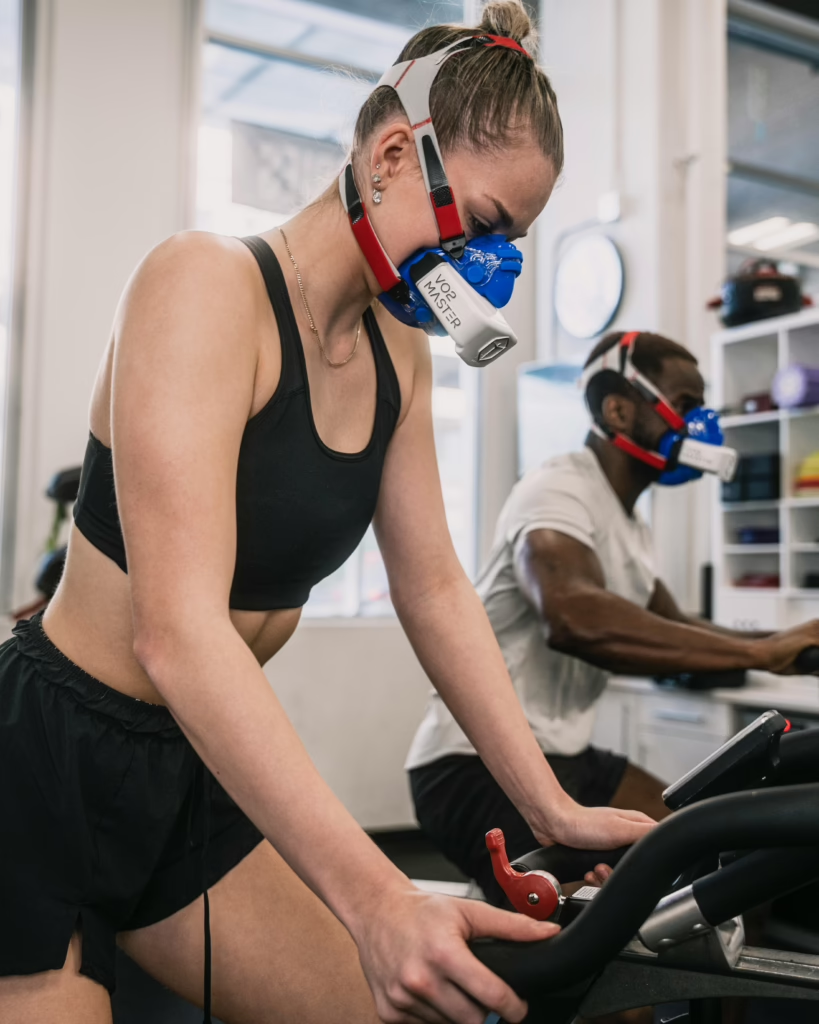
The most accurate measurement of VO2 max occurs in a laboratory using metabolic testing.
During this test, an individual exercises on a treadmill or stationary bike while wearing a mask that measures oxygen intake and carbon dioxide output. The intensity gradually increases until the participant reaches maximal exertion. Researchers then determine the highest level of oxygen consumption achieved during the test.
Because laboratory testing is not always practical, exercise scientists have developed validated equations that estimate VO2 max using distance, time, heart rate, and demographic variables.
2. Cooper Test
One widely used method is the Cooper twelve minute run test, developed by physician Kenneth Cooper for the U.S. Air Force. The test measures how far a person can run in twelve minutes.
The equation used is:
VO2 max = (distance in meters − 504.9) ÷ 44.73
Another common estimate comes from the 1.5 mile run test, which uses completion time.
VO2 max = 3.5 + (483 ÷ time in minutes)
3. Rockport Test
For individuals who prefer walking, the Rockport one mile walking test incorporates walking time, heart rate, age, weight, and sex.
VO2 max =
132.853 − (0.0769 × body weight in pounds)
− (0.3877 × age)
(6.315 × sex)
− (3.2649 × walk time in minutes)
− (0.1565 × heart rate)
In this formula, sex is coded as 1 for men and 0 for women.
Research comparing these field tests with laboratory measurements shows that they provide moderately strong correlations with directly measured VO2 max, which is why they are widely used in athletic training and population health studies.
Wearable devices such as Apple Watch and Garmin use similar physiological models to estimate VO2 max during runs or brisk walks.
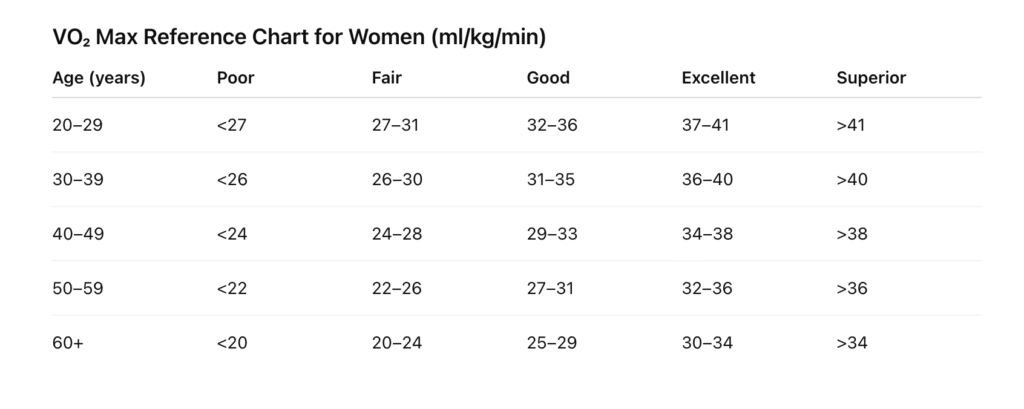
VO₂ Max Charts By Age and Gender
Find your age group below and compare your VO₂ max to the ranges.
Focus on tracking progress over time; even small increases reflect real improvements in heart, lung, and muscle efficiency.
Use the results to guide your training. For example, if your VO₂ max is in the fair or poor range, adding consistent aerobic exercise and interval work can lead to meaningful gains.

Factors That Influence VO2 Max
VO2 max varies between individuals for several reasons. Some of this variation reflects genetics, but lifestyle and training also play a significant role.
Training history
Regular aerobic exercise improves oxygen delivery and utilization.
Age
VO2 max tends to decline gradually with age, although training can slow that decline.
Body composition
Higher muscle mass and lower body fat often support better aerobic capacity.
Testing accuracy
Laboratory tests provide precise measurements, while field tests and wearable devices provide estimates.
Effort level during testing
Field tests require near maximal effort to produce meaningful results.
Because the metric reflects the performance of multiple physiological systems, improvements in VO2 max often indicate meaningful changes in cardiovascular fitness.
Using VO2 Max to Guide an Exercise Plan
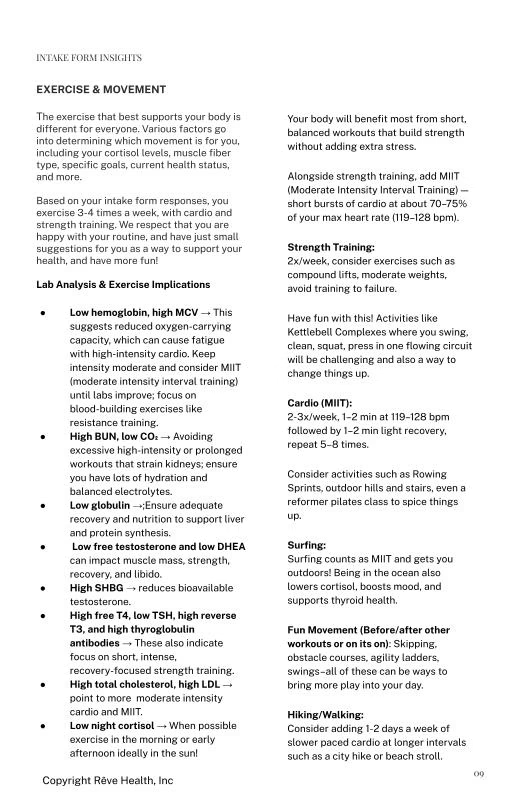
VO2 max becomes most useful when it is used to guide training. Improving aerobic capacity typically requires a combination of steady cardiovascular work and occasional higher intensity efforts.
A simple weekly structure might include:
Aerobic base training
• Brisk walking, jogging, cycling, or swimming
• 30 to 45 minutes per session
• Three to four sessions per week
• Intensity where conversation is still possible
Moderate intensity sessions
• Slightly faster pace that increases breathing and heart rate
• 20 to 30 minutes
• One to two sessions per week
Higher intensity intervals
• Short bursts of faster effort followed by recovery
• Example: one minute of fast running followed by two minutes of easy movement
• Repeat six to eight cycles
• One session per week
Strength training
• Two sessions per week
• Focus on large muscle groups such as legs and back
• Stronger muscles improve oxygen utilization during exercise
Repeating a field test every six to eight weeks can help track improvements in aerobic capacity.
The Takeaway
VO2 max provides a powerful window into cardiovascular health because it reflects the integrated performance of the heart, lungs, and muscles during physical stress.
Research continues to show that higher cardiorespiratory fitness is associated with lower risk of disease and longer lifespan.
The encouraging part is that aerobic capacity responds to consistent training. Even modest improvements in cardiovascular fitness can produce meaningful changes over time.