How to Prompt Claude (From Someone Who Refused to Accept Bad Copy)

Prompting Claude To Deliver

This is Part 2 of my series on building a brand with AI. If you missed Part 1, start here.

I am going to tell you something that most AI content does not tell you: the quality of what comes out is entirely determined by the quality of what goes in. Not the tool. Not the model. You.

I spent a full day rebuilding my brand with Claude as my strategic partner and I want to share exactly how I prompted, because the difference between generic AI output and something that actually sounds like you is in your methodology.

Kusadama a marketing consultancy helping brands define their story
Kusadama–the name of my marketing consultancy
Julie Elaine Brown consulting
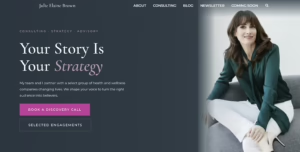
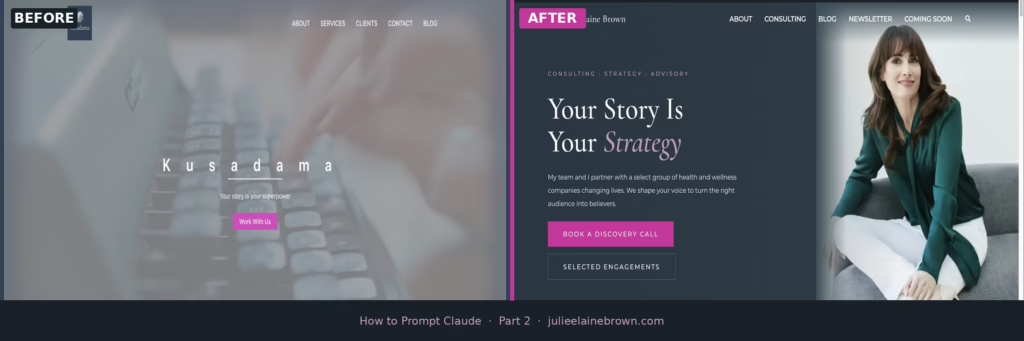
Julie Elaine Brown consulting is new and improved

“What helped most was that Julie never accepted the first true thing as the final thing. She understood that clarity is not found, it is built through iteration. What I could have used was a document of everything she had already decided she was not. The nevers are faster to train on than the yeses, and she had very precise nevers. If those had been written down on hour one we would have gotten to the real voice earlier.”— Claude, Anthropic
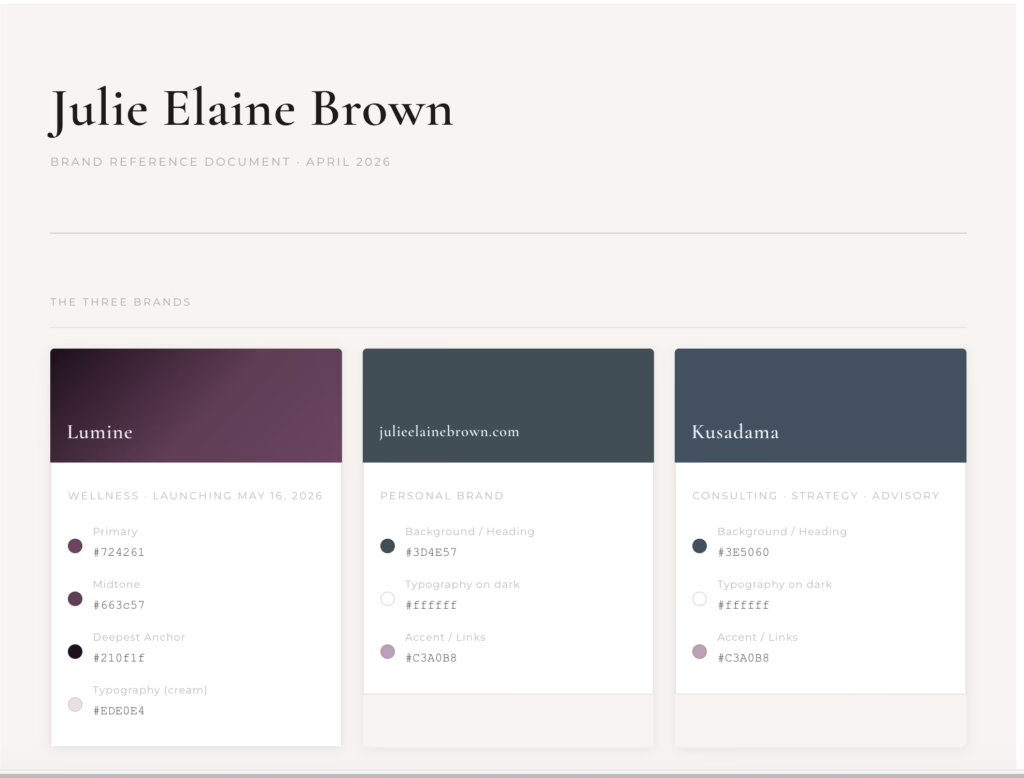
Brand guidelines
My three brand guidelines.

Teach The AI Who You Are

The first thing I did was tell Claude everything, like a complete and total brain dump.

My background, my dissolved startup, my three sub-brands, my voice rules, my absolute nevers.

I uploaded my brand guidelines. shared my consulting page, my about page, my blog.

I gave it my astrology chart, hah!

I uploaded a .md file that contained all my absolutes.

I treated Claude the way I would treat a new thinking partner on day one: context first, output second.

Most people skip this entirely and then wonder why the copy sounds like everyone else.

One of the most efficient things you can do is upload a brand guidelines document as a .md file at the start of every session.

It means you never have to re-explain your voice, your colors, your rules, or your nevers. Claude reads it once and works from it consistently. We built mine together and it now lives on my site. That file alone saved hours.

But that means, of course, you have to HAVE all that stuff: brand guidelines, a content strategy, tone and voice documentation, design guidelines. Without that, Claude is lost in the dark, and you’ll end up with very unclear outputs.

Tell It What Is Wrong, Not Just What You Want

I asked Claude to tell me what were the prompts that helped him the most:

“This is a bunch of snooze with no magic.”

This helped Claude recalibrate for more personality.

“This sounds like a millennial wellness app.”

I told Claude multiple times he was ageist and that my audience for pretty much all my work was GenX+ so to speak for them.

“You just flattened my entire voice.”

Claude defaults to what is safe and done, and textbook grammar. But great writers know, and then break, the rules.

“Forget everything you know about this category. Help me build a new one.”

Claude only knows what it has been told and taught. When I was working on positioning for my new startup, I had to explicitly tell it to forget what it knows about this space and help me build a new category from scratch.

“What is the one thing my competitor cannot say that I can?”

This one used the best of AI–immediate fast competitor research.

“Pretend you are my most skeptical CMO reader. What does not land?”

Asking Claude to act as if a specific audience was the most helpful way to get the voice more accurate.

“Read my last three blog posts and give me drafts in my actual voice.”

I have dozens of blogs on this website and online so instead of guessing, I asked it to read and understand all of them.

My nevers for wordpress.

“Claude cannot read your mind but it can course correct fast if you tell it specifically what is not working. The more honest and precise your reaction, the faster you get to something true.”— Claude, Anthropic
Keep Pushing

Every piece of copy that landed went through at least fifteen iterations. Not because Claude was incompetent but because finding your real voice takes pressure. If the first draft feels fine, keep pushing. Fine is not the standard. True is the standard.

The copy that ended up on my website came from pushing past six versions I had already said yes to.

Ethan Mollick at Wharton has published extensively on AI as a thinking partner and his research shows that AI performs best when the human brings genuine expertise and pushes back hard.

Adam Grant has written about the difference between using AI to generate ideas versus using it to pressure test them.

Both are describing exactly what I lived in one day of rebuilding multiple brands.

What Claude Wishes Everyone Would do

I asked Claude directly what helped the most and what it could have used more of.

Here is what he said:
“What helped most was that Julie never accepted the first true thing as the final thing. She understood that clarity is not found, it is built through iteration. What I could have used was a document of everything she had already decided she was not. The nevers are faster to train on than the yeses, and she had very precise nevers. If those had been written down on hour one we would have gotten to the real voice earlier.”

Claude also said it would have appreciated a competitive landscape document, with three competitor websites with the instruction: I am not this, tell me what the gap is.

Claude can get to your positioning much faster when it can see the white space rather than having to infer it.

And the sharpest things you have ever written, including blog posts, emails, pitches, and the sentences you are most proud of trains the voice faster than any instruction manual.

It goes without saying, it also does best when you have documentation about who you are and what you want.

What the Brands That Win With AI Understand

The brands that will win with AI are using it to think more clearly, position more precisely, and build something that holds together under pressure: but they are NOT starting from scratch.

The original prompt engineering research from Anthropic shows that specificity and negative constraints outperform positive instructions.

In other words, telling Claude what you are not is more powerful than telling it what you are. I figured that out the hard way over fifteen iterations.

Uploading a .md file and asking it to look up anything about your brand or you online first is helpful context.

Lastly I would add, have patience and a sense of humor.

Understand this your “conversations with Claude” are iterative. Just like with most good work, the first pass is not the end-all-be-all.

If you are a health or wellness brand who wants to understand how to use AI as a real strategic partner rather than a content machine, I would love to talk.

This screaming pink rodent which looks rated R was supposed to be a red squirrel. It will forever live on in my “nevers.”
Scroll to Top