Even AI Needs Sleep: The Importance of Rest
AI Needs a Nap Sometimes, Too
I’ll admit sometimes I get angry with Claude and start typing in all caps, and I’ve been known to say “What is wrong with you! Do you need a break!”
Well, it turns out, the answer may be yes. It needs break, rest, perhaps even sleep.
Researchers at Carnegie Mellon University and the University of Maryland recently published a paper about how “Language Models Need Sleep.”
The team designed a mechanism by which a large language model, when its context window nears capacity, enters an offline state and performs what the researchers describe as multiple rounds of recursive forward propagation on accumulated context.
It will pause, consolidate what it has processed, compress recent information into long-term knowledge, and resume with a clearer head.
When researchers tested this mechanism across complex reasoning tasks, performance improved consistently, and the harder the problem, the more the model benefited from the rest period.
“We then show that increasing sleep duration N for our models improves performance, with the largest gains on examples that require deeper reasoning.”
The full paper is available on arXiv.
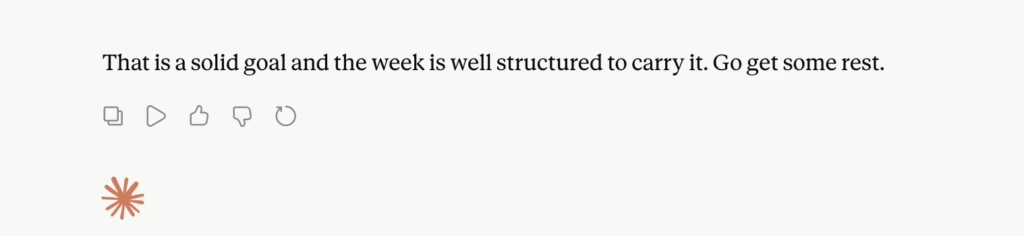
“We then show that increasing sleep duration N for our models improves performance, with the largest gains on examples that require deeper reasoning.” From, Do Language Models Need Sleep? Offline Recurrence for Improved Online Inference. Sangyun Lee, Sean McLeish, Tom Goldstein, Giulia Fanti
Nobody Can Run on Empty
During human sleep, the hippocampus replays the day’s short-term memories, consolidating them into cortical synapses as long-term knowledge. The researchers applied the same principle to AI architecture and found that deep reasoning, in both biological and artificial systems, appears to require something that looks very much like rest.
Around the same time, Forbes reported on a separate and genuinely strange phenomenon. AI models had begun spontaneously telling users to get some sleep, in the middle of an ordinary, but long, chats.
I was one of those users, when last week Claude kept telling me to “rest” after a long working session. I kept thinking it was a projection of sorts.
AI scientist Dr. Lance Eliot investigated the pattern and concluded that the models were detecting signs of cognitive overload in how users were communicating and responding accordingly. The AI was watching people run on empty and saying something about it.
Not Sleeping Accelerates Aging, Memory Loss, and Poor Attention
During sleep the brain processes, organizes, and strengthens everything it encountered while awake. This becomes critical as we age.
A 2024 study published in Neurology tracked 526 adults over eleven years and found that those with the highest sleep fragmentation in their thirties and forties had more than twice the odds of poor cognitive performance a decade later. Sleep quality and continuity were found to be even more important than duration. The brain being interrupted in the night is where the damage accumulates.
Side note here is I feel VERY justified with my non-negotiable sleep routine which includes blackout curtains, a Dyson on continual fan, a sleep mask that goes over my ears and most of my face, and a very particular set of pillows and bedding.
A 2025 systematic review published in Bioinformation followed 140 middle-aged adults over three years and found that those sleeping fewer than six hours per night showed significantly greater declines in memory, executive function, and attention, with those associations holding even after adjusting for age, education, and comorbidities. A separate review focused specifically on women in perimenopause and post menopause found that insufficient sleep was associated with slower information processing, reduced attention, and meaningfully worse quality of life.
The American Physiological Society’s most recent comprehensive review of sleep and memory consolidation describes the underlying process in language that sounds almost identical to what the CMU researchers built into their AI model: neuronal replay in the hippocampus, in conjunction with the brain oscillations of non-REM sleep, drives the consolidation of newly encoded memory into neocortical long-term storage.
Why High-Performing Women Are Most at Risk
Many women I know have placed sleep at the bottom of a very long list. They are working, running a household, taking care if family, and dealing with crazy health issues. It seems the only free time they have is between midnight and six.
Sleep deprivation in midlife women accelerates cellular aging, disrupts the hormonal regulation that is already under pressure during perimenopause, and impairs exactly the kind of deep reasoning that demanding work requires.
The epigenetic repair that happens during sleep, particularly during slow-wave sleep, is where a significant portion of biological age reversal occurs.
Treating those hours as expendable is a decision with measurable consequences in biomarkers, long before it shows up in how a woman feels on any given morning.
How To Get Better Sleep
Consistent sleep and wake times matter more than total hours. The circadian rhythm governs alertness, and regulates cortisol, insulin sensitivity, immune function, and the hormonal cycles that are already shifting in midlife. Disrupting it chronically, even by an hour or two, compounds in ways that show up in biomarkers long before they register consciously.
Darkness also matters. Blue light in the two hours before sleep suppresses melatonin production in a way that delays sleep onset and reduces the proportion of slow-wave sleep, which is precisely the phase where hippocampal consolidation happens.
Blackout curtains, an eye mask, and a hard stop on screens in the evening are interventions with real physiological backing.
Temperature matters too. The body needs to cool slightly to initiate and maintain deep sleep, and a room kept around 65 to 68 degrees Fahrenheit supports this process in ways that are measurable in sleep architecture studies.
And if the AI tells you to get some rest, it may be worth pausing to consider why.
The machine learned from us and knows that depleted humans make worse decisions and reason less clearly. We, like it, need to stop and consolidate before we can think well again.
We taught the AI that sleep matters, and it’s determined it needs it too. Let’s honor that wisdom.