The Fitness Framework That Turns Out To Be a BluePrint For Life
(and helped me get my shit together after my life fell apart)
The OPT Model For Fitness Turns Out To Be a Cheat Sheet for Life
I was studying for my NASM certification and their proprietary framework: the OPT model. It turns out OPT isn’t just a framework for exercise, it’s a blueprint for getting life back on track, a literal phoenix from the ashes.
If you have ever tried to rebuild anything whether it’s your health, your confidence or sense of direction, while everything around was chaos, the OPT framework can help, let me explain.
A project manager at one of my first jobs (Razorfish, an ad agency) used to say you can’t gestate a baby in 3 months, and you can’t create from chaos. (Not sure these relate to each other, and Lynn had more nuggets, but that’s for another day).
A friend who writes about startups and life design suggested I re-certify as a personal trainer to create structure in my days (in fact he recommended the same thing to me after my ecommerce startup was acquired back in 2012, when I was aimless and lacked clarity).
His belief system is one small thing each day helps you feel accomplished (for example, making your bed). A small victory creates an immediate sense of accomplishment and order. Small, controlled tasks provide a psychological “win.” That win compounds and helps you feel more optimistic about doing more things.

Baby Steps To Greatness
I decided to get certified as a personal trainer through NASM (National Academy of Sports Medicine) which of course is the most challenging course (I figured this would help me feel more accomplished). I previously have held CPT with AFAA.
I committed to studying an hour each morning after I walked my dog (FYI I’m on Chapter 11).
“The secret of getting ahead is getting started. The secret of getting started is breaking your complex, overwhelming tasks into small manageable tasks, and then starting on the first one.” — Mark Twain
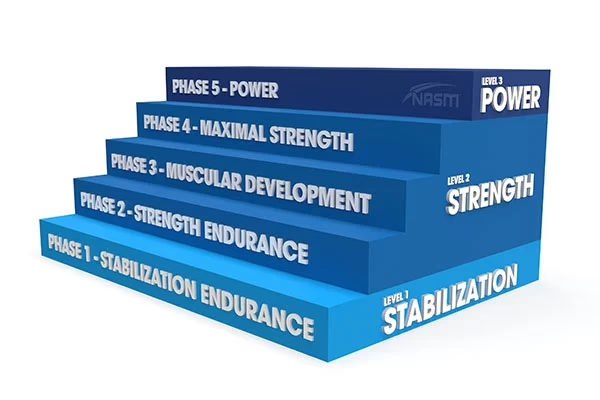
NASM, the National Academy of Sports Medicine, is one of the most rigorous and widely respected certifying bodies in fitness. Their Optimum Performance Training model, known as OPT, is the foundational framework behind how certified trainers design programming for their clients.
It is built on decades of exercise science, and it is structured around a deceptively simple premise: you cannot build power on an unstable foundation.
The model has three core phases:
Stabilization.
Strength.
Power.
Each one is a prerequisite for the next and has a distinct physiological purpose as well as an emotional purpose.
Phase One: Stabilization
In the OPT model, all training begins with stabilization.
Everyone wants to do the sexy things—lift heavy shit, fly over boxes, sprint, but before any of that, the body must be stable. Or even if you are not interested in power moves or HIIT, many people want to do big things like go for a few mile hike or take a spin class when they are starting from the beginning.
That’s how injuries occur, or people get burned out too fast.
In the OPT model the Stabilization phase trains the neuromuscular system to activate the right muscles in the right sequence, to create a stable base that can support everything built on top of it.
The research behind this phase is grounded in the work of scientists like Vladimir Janda and Shirley Sahrmann, who demonstrated that dysfunction in foundational movement patterns leads to compensation, and eventually to injury, regardless of how strong the surface structure appears.
Now, let me draw the obvious parallel to life in general, even though I know you’re already there with me.
Every time I have rushed into something, the instability eventually showed up whether in a business or relationship or with something I’m learning.
The science is clear, that no matter the endeavor, stabilization is necessary.
Real world tips
1. Identify one area of your life that lacks a stable foundation. This could be as simple as cleaning out your closet and organizing things before buying anything new or going back to the basics with a fledging business.
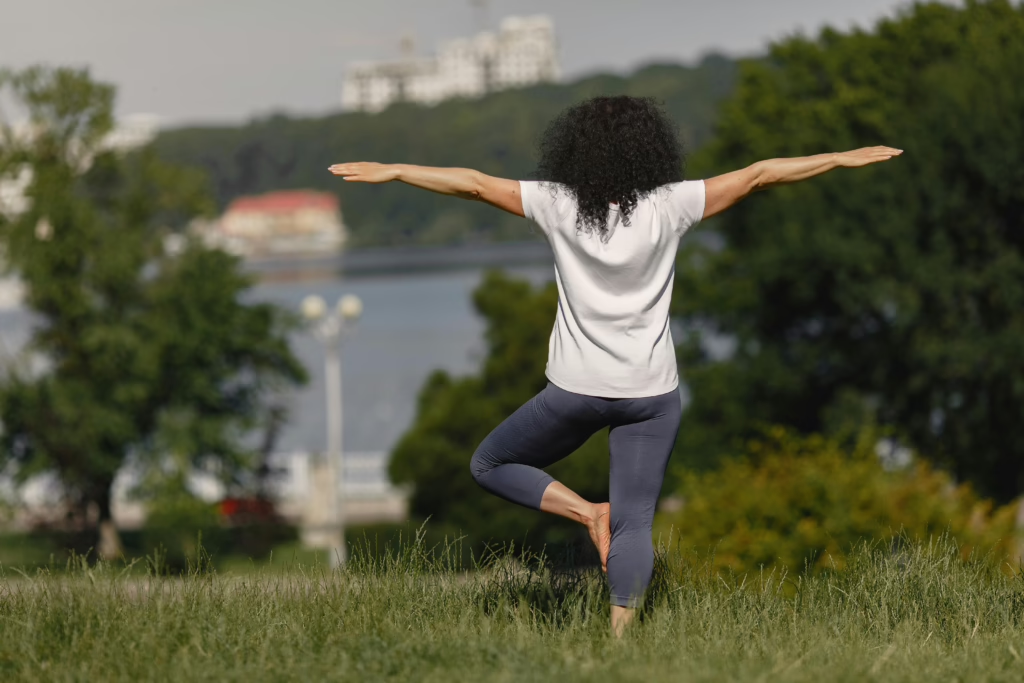
2. If you are starting an exercise program, or your exercise routine isn’t really working for you, go back to the basics here as well. Begin with core and balance activities, such as planks or standing on a bosu ball, or even doing poses like “tree” in Yoga where one foot is places against the thigh of the opposite leg.
3. Ask yourself honestly where you are compensating or what I call chaos-ing with anything in life (flailing hands all over with “tree?” or shoving things into a everything drawer in your house?). Compensation is always a signal that stabilization work is still needed.
Phase Two: Strength
Once you have a strong foundation, the NASM OPT model moves into strength training.
This is the lift heavy shit phase, and fyi your own body regardless of its size is heavy shit in the sense that you can use your own body weight to strength train. Squats, lunges, step-ups and RDLs (Romanian dead lifts) can be done without weights.
This phase is about progressive overload, which really is asking your body to slowly handle MORE and get used to it.
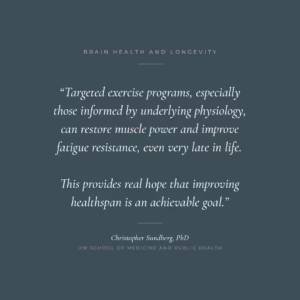
Studies published in journals including the Journal of Strength and Conditioning Research have consistently shown that strength training is one of the most powerful interventions available for preserving muscle mass, improving metabolic function, protecting bone density, and reducing the physiological markers of aging.
Small tears in muscles—hypertrophy—is what helps muscles grow. Small pinpricks in our faces for microneedling causes collagen to grow. Progressive learning causes Neuroplasticity, which in layman’s terms is helping the brain grow.
In life, we get better when we progressively take on more challenging work, push ourselves to our limits.
Now this isn’t to say we are supposed to completely suffer like in the Count of Monte Cristo (tho right as my startup was dissolving I had some ruminous thoughts about this book), or hurt ourselves or be in pain—but getting to the next level whether in fitness or in life, requires getting comfortable with being uncomfortable. And…especially for the over 50 crowd, it means building in more recovery time to enable healing.
Real world tips
1. Resistance training especially as we age is critical. Commit to a progressive strength protocol two to three times per week and track your progress over months, not weeks.
2. In your life, name one area where you have been avoiding progressive challenge. Identify the smallest meaningful step into it and take it this week. This could be something like, avoiding doom scrolling at night. Start putting the phone away even 5 minutes earlier each day, until you are up to a few hours before bedtime. Sounds impossible at first, but 5 minutes a day equals an hour of time in 12 days!
3. Strength requires recovery. Build rest into your training and your schedule with the same intentionality you bring to your effort.
Phase Three: Power
Power is the final phase of the OPT model, and in exercise science it refers to the integration of strength and speed: the ability to produce force rapidly, with control, and at full expression.
This is the phase that most people romanticize and rush toward but power training on an unprepared body produces diminishing returns and elevated injury risk.
Researchers at institutions including the Mayo Clinic have studied power output in older adults and found that power declines faster with age than strength alone, and that targeted power training produces significant gains in functional capacity, balance, and quality of life.
However, our bodies do not stop responding to intelligent training as we age, especially when done with a certified personal trainer or a physical therapist!
Once a skill is stabilized, the next step is acceleration.
You take what you have already built and begin executing it faster, with greater ease and less conscious effort. In fitness, this looks like pairing a heavy squat with an explosive squat jump. In life, this means tackling your most demanding task of the day and following it with a rapid, high output work session. High force, then high velocity.
Power training builds neuromuscular efficiency, improving your reaction time and movement quality across everything you do, inside the gym and throughout your daily life.
When your habits run on automation, your mental energy becomes available for what truly matter.
People who train for power develop a remarkable ability to adapt. They respond to new demands quickly, pivot with confidence, and bring both speed and intention to whatever life asks of them.
Power is powerful.
Real world tips
1. Power training includes explosive movements like jump squats, medicine ball throws, and plyometric variations. Work with a trainer to assess readiness before adding power work.
2. In your life, ask yourself what your day to day might look like in a few years if you started something today that you’ve always wanted to do. In a few years you could start a business, learn a foreign language, get a master’s degree, travel to several countries, plant a garden…but none of those things are possible without taking the first step.
3. Power is sustainable only with recovery. The athletes who perform at the highest level also rest at the highest level. I know so many entrepreneurs who fail to get enough sleep or rest time, and the reality is, especially as we age, it does not serve us. We cannot do our best work without being rested.
Build the Foundation
The OPT model is built on a premise that we require a stable foundation before building upon it. It’s a solid belief system for fitness and for life!
I will be creating a small program related to this and helping women over 40 especially rebuild solid foundations soon!